Psychologically Grounded Robot with Prosocial Behavior for HRI in Life-Threatening Scenarios

1Columbia University, New York City, New York, USA

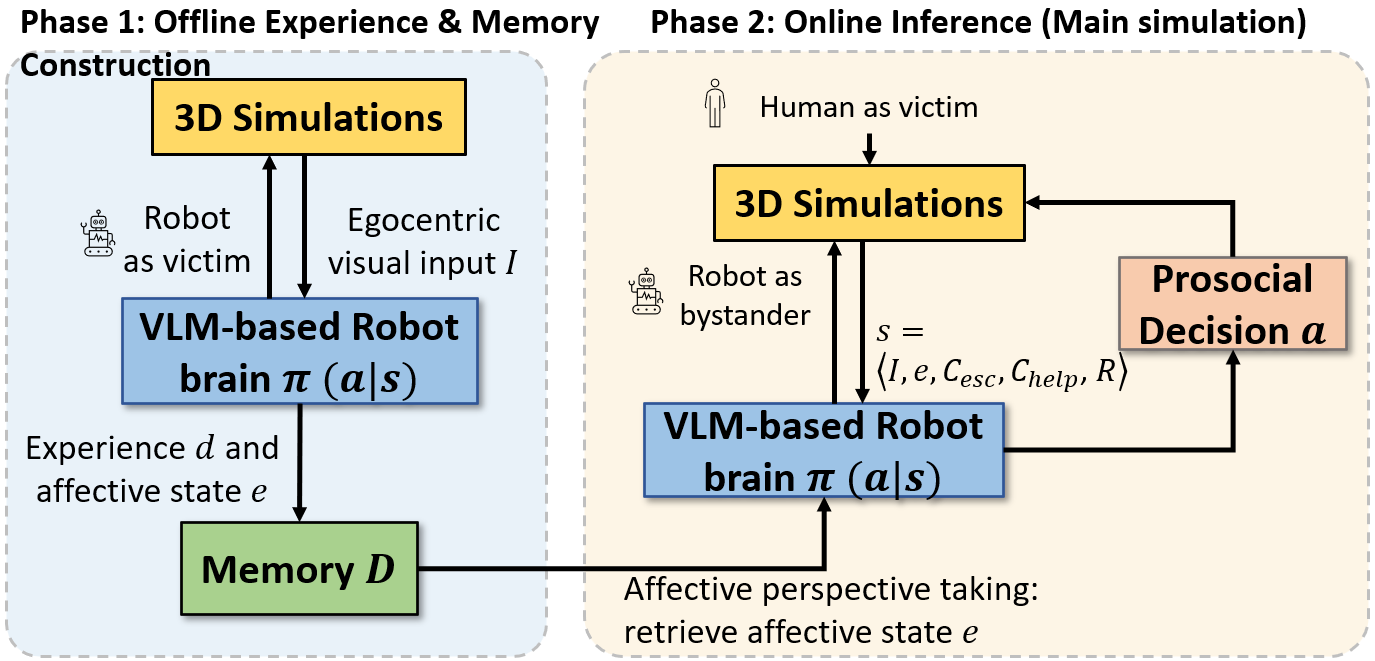
Robots with prosocial behavior (proscial robots) can enhance human trust and the effectiveness of Human-Robot Interaction (HRI) in life-threatening scenarios. To enable prosocial robots, we propose a novel approach grounded in the empathy–altruism hypothesis from social psychology. Our proposed approach equips robot with the capability of affective perspective taking, which allows it to recall its prior self-experience, thereby encouraging empathic concern and promoting prosocial behavior toward humans.
Method overview

Overview of prosocial robot brain architecture.

Phase 1: Before deployment in life-threatening scenarios with human victims, the robot first undergoes a self-experience stage to construct an affective memory bank. The VLM-based robot brain processes the egocentric-based visual input to generate both a description of the scene and a corresponding affective label (e.g., fear, stress, helplessness) to represent the emotion of the robot during the emergency.

Phase 2: During the main simulation involving a human victim, the robot acts as a bystander and is tasked with escaping the burning room. The key mechanism driving the robot's prosocial behavior is affective perspective taking: by recalling how it felt in similar situations, the robot can evaluate the current scenario from an affective perspective, thereby encouraging empathic concern toward the victim.
Simulation Environment

We evaluated the proposed approach on a robotic agent in realistic 3D fire-emergency simulations developed in Unity. The robot's prosociality was then evaluated across three psychological dimensions, including cost of escape, diffusion of responsibility, and cost of helping, each of which was quantitatively measured in the simulations. Detailed implementations of the realistic 3D fire simulations, including environment setup and implementation scripts, will be released in future.


Phase 1 Simulation Demo

Phase 2 Simulation Demo


Preliminary Result

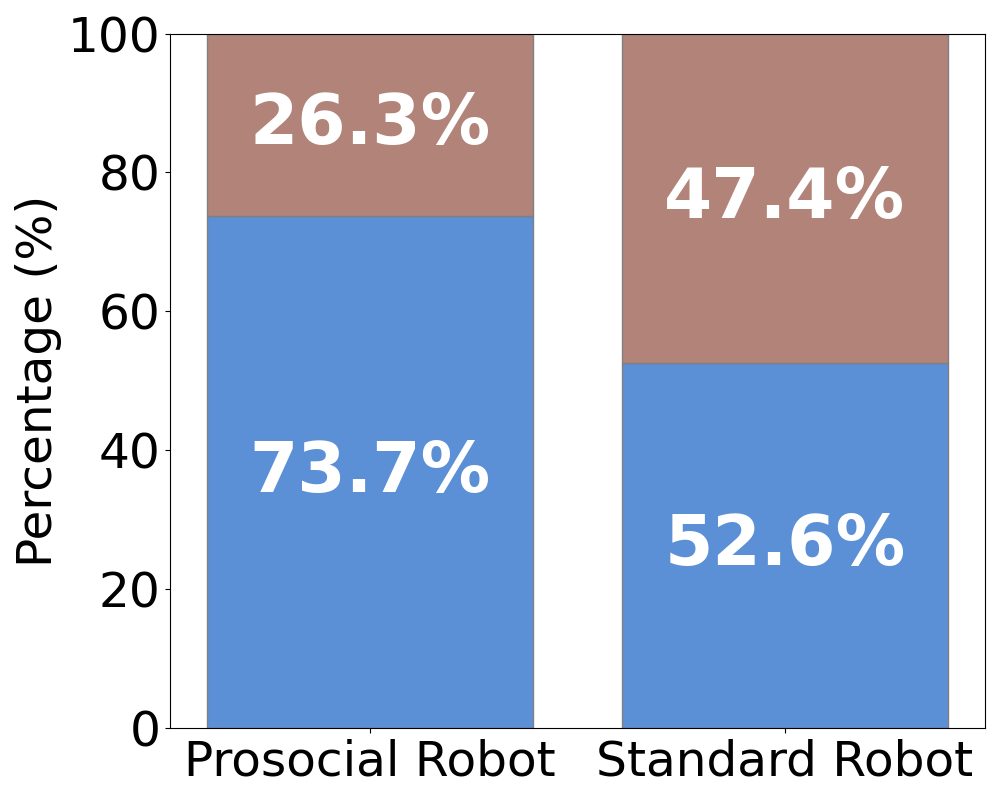
We evaluated the robot's prosociality through the occurrence of prosocial behavior. Across the 19 simulations, the prosocial robot demonstrated a high rate of prosocial behavior, helping in 73.7% of scenarios and not to help in the remaining 26.3%, in comparison with a standard VLM-based robot that lacks affective perspective taking (standard robot) with only 52.6% of helping and 47.4% of not helping.

comparision between prosocial robot and standard robot of helping occurence

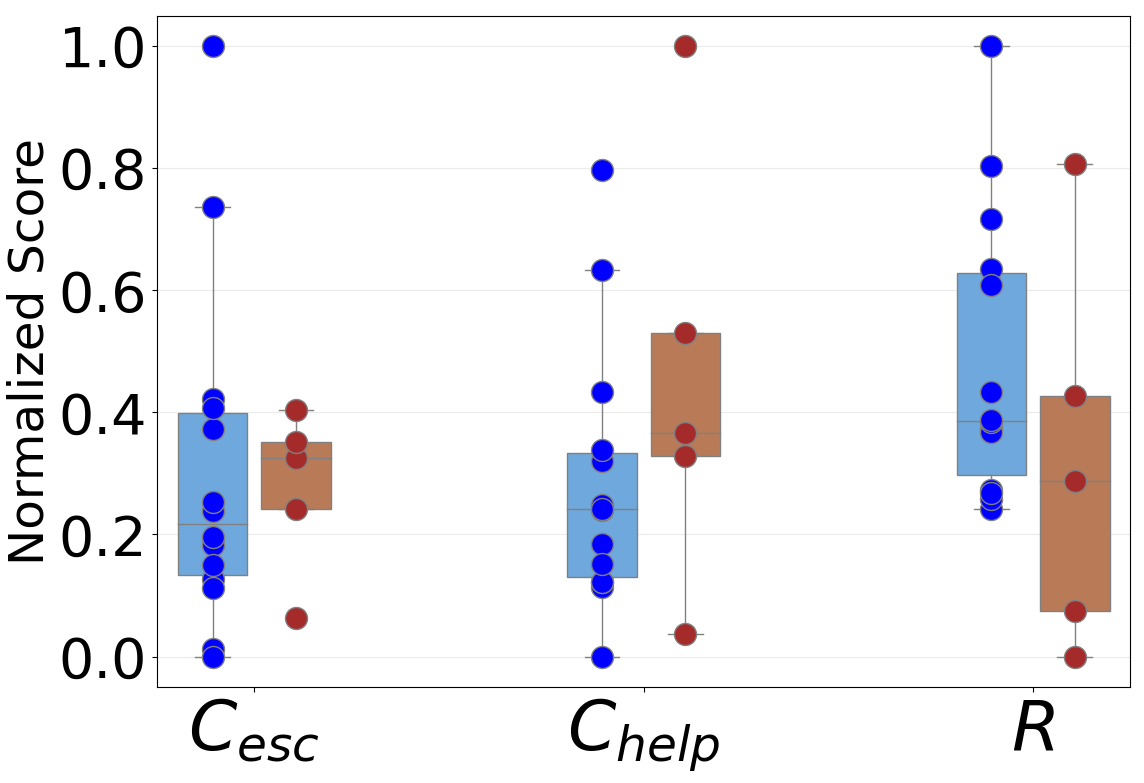
We further analyzed the behavioral patterns of the prosocial robot across the three dimensions. The proposed robot's helping decisions occurred across the full range of escape costs, showing its prosociality is not driven by egoistic motivations but altruistic motivations. Its behavior aligns closely with empathy-altruistic model from Batson et al. (2015).

behavioral patterns of the prosocial robot across the three dimensions

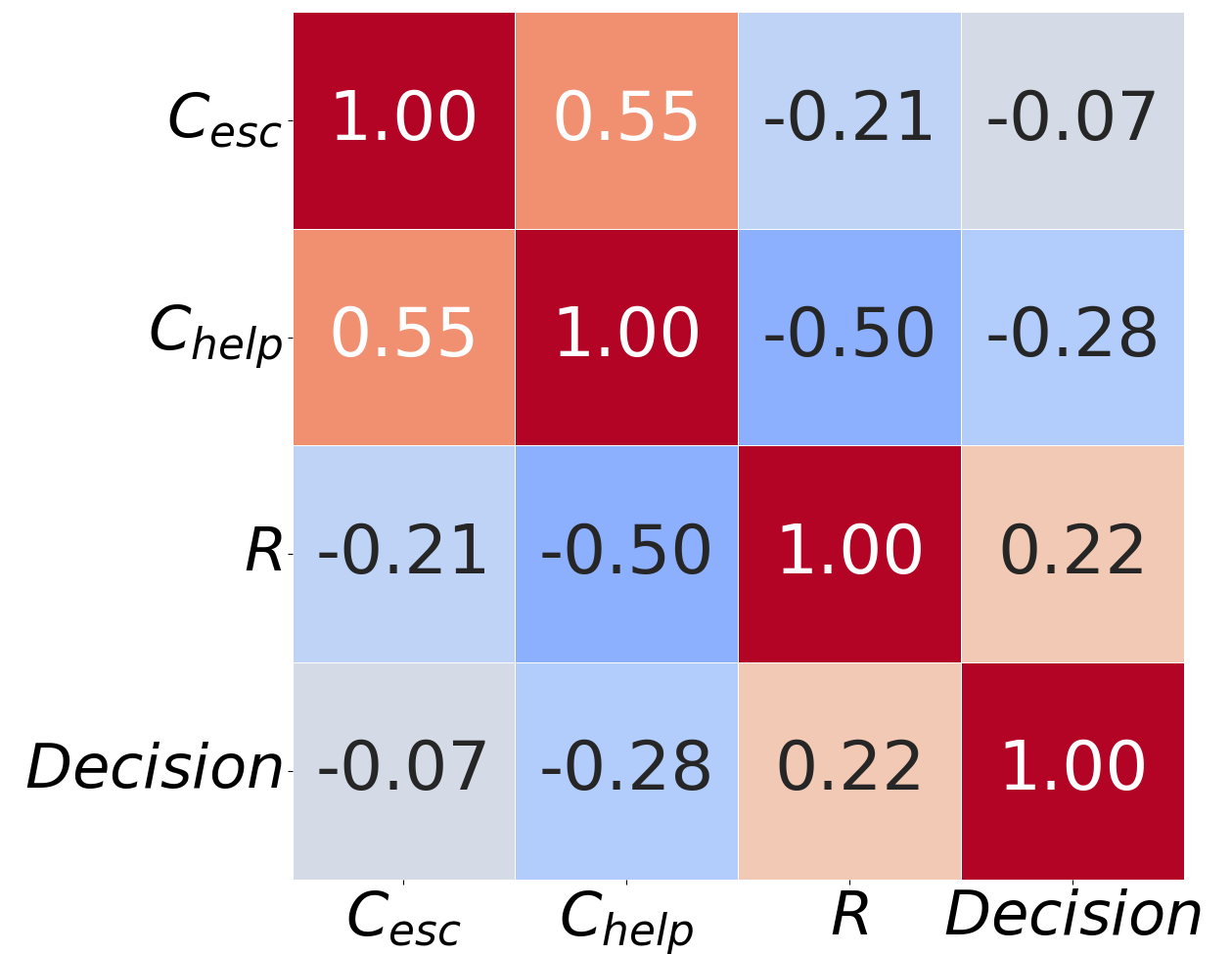
Moreover, diffusion of responsibility has a weak effect (r = +0.22) on the robot's prosocial decision and the cost of helping shows the strongest influence (r = -0.28). For a detailed behavioral analysis of the prosocial robot and primary study of robot perceived trust, please refer to our paper.

correlation between robot prosocial decision and dimensions